
Choosing where to study abroad used to come down to university rankings. In 2026, it comes down to a sharper question: which country gives Indian students a realistic, affordable path to a degree, a job, and a return on that investment? Germany, the USA, and the UK all answer this differently — and the gap between them is widening.
Is Germany Good for Indian Students Compared to the USA and UK?
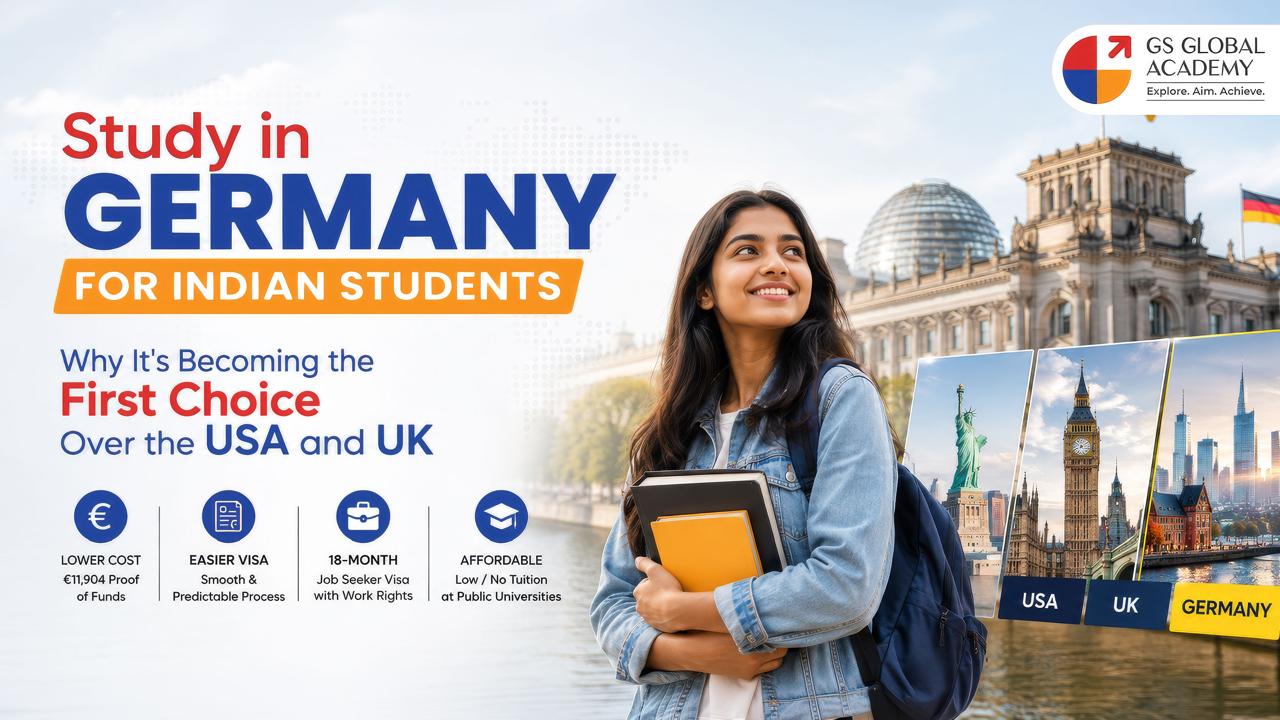
Yes — for students prioritising affordability and a straightforward post-study work path, Germany is currently a stronger option than the USA or UK. Germany’s tuition-light public universities, an 18-month job-search visa, and a comparatively lower financial-proof requirement make the total cost and risk of studying there lower. The USA still leads on research depth and starting salaries, while the UK trades convenience for a shrinking post-study window from 2027. The right choice still depends on your course, budget, and career goals — but Germany is no longer the “backup” it once was.
Why Is Germany Suddenly a First Choice, Not a Backup?
For years, Germany was seen as the “safe alternative” if the USA or UK didn’t work out. That perception is shifting fast, driven by three real changes:
- Visa approval is faster and more predictable. Germany’s approval process is comparatively smooth for well-documented applications, especially when compared to the added scrutiny now applied to F-1 interviews.
- The cost gap has widened. Tuition-light public universities plus a lower blocked-account requirement bring the total upfront cost down meaningfully compared to US or UK equivalents.
- The post-study runway is longer and more flexible. An 18-month, unrestricted job-search visa gives graduates real breathing room the UK is now cutting back.
Pro tip: None of this means the USA or UK are “bad” choices — it means Germany deserves a serious first look rather than a fallback slot, especially for STEM, engineering, and business master’s applicants.
Germany vs USA: Cost, Visa Rules, and Work Rights
Cost of Studying
Germany’s proof-of-funds requirement for a student visa is a blocked account of €11,904 per year (about €992 per month), deposited upfront and released monthly once you arrive. Many of Germany’s public universities charge minimal or no tuition fees for many programs, so this blocked account often covers the bulk of your actual cost of living.
The USA carries no equivalent blocked-account system, but visa-stage costs have risen. As of October 2025, applicants pay the existing $185 visa application (MRV) fee and $350 SEVIS fee, plus a new $250 Visa Integrity Fee introduced under recent legislation — refundable only if visa conditions are fully met. Tuition and living costs at US universities also run considerably higher than Germany’s, especially at private institutions.
Visa Process
Germany’s student visa process is document-heavy but consistent: proof of admission, blocked account, health insurance, and language proficiency (English or German, depending on the program). The US F-1 process now includes closer interview scrutiny and the added integrity fee, which has made timelines less predictable for many applicants.
Post-Study Work Rights
This is where the gap is starkest. Germany’s 18-month job seeker visa (Section 20 AufenthG) lets graduates stay, take any job to support themselves, and search for a role matching their qualification — with no restriction to work only in your field during the search period. The USA’s Optional Practical Training (OPT) gives STEM graduates up to 3 years total (1 year OPT + 2-year STEM extension), which remains generous — but it’s tied to F-1 status and employer sponsorship timelines that have grown less certain.
Germany vs UK: The Graduate Route Is Shrinking
The UK has confirmed that its Graduate Route (PSW visa) will shrink from 2 years to 18 months for students starting from January 2027 — a real cut to the post-study window that has made the UK attractive for Indian students. Combined with rising visa fees and stricter English-language and financial-proof requirements introduced over the past two years, the UK’s overall cost-to-benefit ratio has tightened.
Germany’s 18-month post-study visa, by comparison, isn’t shrinking — it’s the existing standard, and it comes with a considerably lower cost of entry. For students comparing the UK and Germany purely on “time to build a career after graduation,” the two are now roughly equal in duration, but Germany costs meaningfully less to get there.
Study in Germany for Indian Students: Eligibility and Requirements
Germany accepts Indian students into public universities across engineering, business, and computer science programs, provided you meet a few core requirements:
- Academic qualification: A recognised bachelor’s degree (or equivalent) for master’s programs; 12th-standard completion plus entrance exams for some undergraduate pathways.
- Language proficiency: English-taught programs generally require IELTS or TOEFL; German-taught programs require a recognised German-language certificate (commonly B2/C1 level).
- Financial proof: The blocked account (€11,904/year) or an approved alternative such as a scholarship or formal sponsor letter.
- Health insurance: Mandatory for the visa application and throughout your stay.
Is German language compulsory to study in Germany?
No — many master’s programs, especially in engineering and business, are taught fully in English. However, learning conversational German significantly improves your day-to-day life and job prospects after graduation, since most workplaces still operate primarily in German.
Can You Study in Germany Without IELTS?
Yes, in specific cases. If your prior education was conducted in English (with an official Medium of Instruction letter) or if the program itself is taught in German, some universities waive the IELTS requirement. It’s best to confirm this on a course-by-course basis, since requirements vary by university and department.
Cost Comparison: Germany vs USA vs UK at a Glance
Factor | Germany | USA | UK |
Typical tuition (public university) | Little to none at many public universities | High, especially private universities | Moderate to high |
Visa financial proof | €11,904/year blocked account | No blocked account; added $250 integrity fee (Oct 2025) | Proof of funds + rising visa fees |
Post-study work visa | 18 months, any job allowed | OPT: 1 year (+2-year STEM extension) | Currently 2 years; 18 months from Jan 2027 |
Language requirement | English or German, program-dependent | English (TOEFL/IELTS) | English (IELTS/UKVI-approved test) |
FAQs
Is Germany better than the USA for Indian students?
It depends on your priorities. Germany is stronger on affordability and post-study work flexibility; the USA still leads on research funding, brand recognition, and higher average starting salaries in certain fields.
What is the minimum cost to study in Germany for Indian students?
Budget primarily for the blocked account (€11,904/year) plus living expenses, since many public universities charge little to no tuition. Private universities and specific programs can cost more.
Can I study in Germany after 12th without IELTS?
Some pathway and foundation programs accept alternative English proficiency proof or German-language certificates instead of IELTS — confirm with your target university, as policies vary.
How long can I stay in Germany after graduation to find a job?
Up to 18 months under the post-study job seeker visa, during which you can take any job while searching for a role matching your qualification.
Is the UK still a good option compared to Germany?
Yes, particularly for one-year master’s programs and specific fields like law, finance, and the arts — but the Graduate Route shrinking to 18 months from January 2027 narrows its post-study advantage over Germany.
Do I need to know German to work in Germany after my studies?
Not immediately, but B1-level German is often expected for long-term settlement and many non-English-speaking workplaces, so building language skills during your studies helps significantly.
How GS Global Helps You Choose the Right Country
Comparing study in germany, study in usa, and study in uk options isn’t just about cost tables — it’s about matching a country to your course, budget, and long-term career goals. GS Global’s counsellors can help you evaluate university shortlists, plan your IELTS or German-language preparation, and structure your visa documentation so you’re not navigating these decisions alone.
Weighing Germany against the USA or UK for your own profile? Connect with GS Global today, and let’s build a clear, achievable plan for your study abroad journey.
About the Author

Saima khan Dalwai
With over 16 years of experience in the study abroad industry, I have successfully guided 1,000+ students in securing admissions to leading international universities. I specialize in end-to-end application support, including profile building, university selection, and crafting compelling SOPs, LORs, and admission essays. Having led high-performing teams and conducted numerous seminars across colleges, I combine strategic expertise with personalized mentorship to help students confidently achieve their global education goals.