

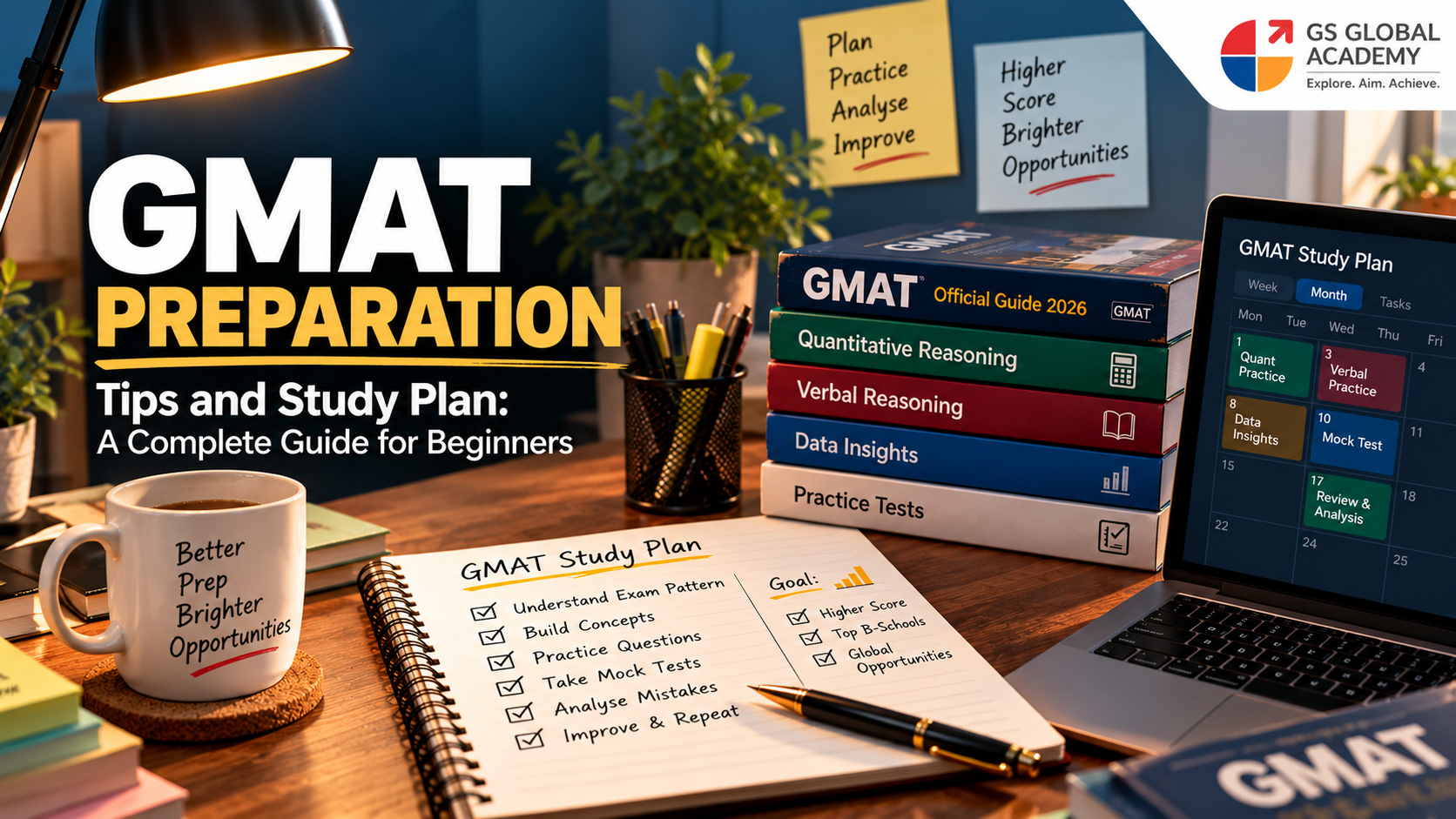
Preparing for the GMAT requires more than solving practice questions. You need to understand the exam format, identify your strengths and weaknesses, follow a realistic study schedule and practise applying concepts under timed conditions. Whether you are beginning your preparation or looking to improve your practice-test performance, a structured approach can make your preparation more focused and efficient. With the right guidance and preparation resources from GS Global Academy, you can build a focused study strategy and work towards your target GMAT score.
The GMAT (Graduate Management Admission Test) is a standardised exam used by business schools to evaluate applicants for MBA and other graduate management programmes. It assesses quantitative reasoning, verbal reasoning and data interpretation skills that are relevant to business education.
If you are wondering how to prepare for the GMAT exam, this guide covers the GMAT syllabus, section-wise preparation strategies, a practical 90-day GMAT study plan, practice questions and tips to help you prepare effectively.
What Is the GMAT Exam?
The GMAT is a computer-based admissions test designed to assess skills relevant to graduate management education. Business schools use GMAT scores alongside other application components, such as academic records, professional experience and application essays, when evaluating candidates.
The current GMAT exam has three sections: Quantitative Reasoning, Verbal Reasoning and Data Insights. Each section contributes equally to the total score.
GMAT Exam Pattern 2026
According to the official GMAT exam information, the current format consists of 64 questions and takes 2 hours and 15 minutes, with one optional 10-minute break.
| Section | Number of Questions | Time |
| Quantitative Reasoning | 21 | 45 minutes |
| Verbal Reasoning | 23 | 45 minutes |
| Data Insights | 20 | 45 minutes |
| Total | 64 | 2 hours 15 minutes |
The total GMAT score ranges from 205 to 805. Each section has its own score, and all three contribute equally to the total score.
The exam also includes a Question Review & Edit feature that allows you to review questions within a section and change up to three answers, subject to the available time. You can select your preferred section order.
Before starting your GMAT test prep, review the latest official GMAT exam structure to understand the current format and test-day features.
What Is the GMAT Exam Syllabus?
Understanding the GMAT exam syllabus is one of the first steps towards building an effective preparation strategy. Each section evaluates a different set of skills, so your study plan should include targeted practice for all three.
1. Quantitative Reasoning
The Quantitative Reasoning section evaluates your ability to solve mathematical problems using arithmetic, elementary algebra and logical reasoning.
Important areas to practise include:
- Arithmetic operations and number properties
- Fractions, decimals, ratios and percentages
- Averages and basic statistics
- Algebraic expressions and equations
- Exponents and roots
- Word problems and quantitative relationships
- Problem-solving techniques and estimation
The section focuses on problem-solving questions. An on-screen calculator is not available in Quantitative Reasoning, so practise calculations and estimation without relying on one.
Preparation tip: Focus on understanding why a method works rather than memorising formulas alone. Once you are comfortable with the fundamentals, practise mixed questions under timed conditions.
2. Verbal Reasoning
Verbal Reasoning measures your ability to understand written information, evaluate arguments and draw logical conclusions.
The two question types are:
- Reading Comprehension: Understand passages, identify main ideas, interpret evidence and draw inferences.
- Critical Reasoning: Evaluate arguments, identify assumptions, strengthen or weaken conclusions and assess reasoning.
The current GMAT Verbal Reasoning section does not include the Sentence Correction questions found in earlier versions of the exam.
Preparation tip: Read the question carefully, identify the author’s conclusion and distinguish evidence from assumptions. After answering, review why the correct option is supported by the passage or argument and why the other options are weaker.
3. Data Insights
Data Insights tests your ability to interpret information from different sources and use it to make logical decisions.
The section includes five question types:
- Data Sufficiency
- Multi-Source Reasoning
- Table Analysis
- Graphics Interpretation
- Two-Part Analysis
Questions may involve numerical information, written passages, charts, tables or a combination of these formats. An on-screen calculator is available in this section.
Preparation tip: Practise extracting relevant information from tables and graphs, comparing multiple data sources and identifying what information is sufficient to answer a question. Avoid making assumptions that are not supported by the information provided.
For detailed section descriptions, consult the official GMAT exam content guide.
How to Prepare for the GMAT Exam: 7 Essential Tips
An effective GMAT preparation strategy combines concept learning, deliberate practice, timed tests and regular performance reviews. Use the following tips to organise your study routine.
1. Take a Diagnostic Test
Begin your GMAT exam preparation with a diagnostic test or official practice exam. This helps you understand your current performance across Quantitative Reasoning, Verbal Reasoning and Data Insights.
Review your results to identify:
- Topics you understand well
- Question types that repeatedly cause mistakes
- Sections where you struggle to manage time
- Concepts that need revision
- Areas where you make avoidable errors
Use these findings to prioritise your preparation rather than spending equal time on every topic.
2. Set a Realistic Target Score
Your target score should reflect the requirements and competitiveness of the business schools you plan to apply to.
Research the latest GMAT score information published by your target programmes, including class profiles and admissions requirements where available. Remember that a GMAT score is only one part of your application.
Set an initial target and review it as you progress through practice tests.
3. Build Strong Fundamentals
Before attempting the most difficult questions, make sure you understand the core concepts in the GMAT syllabus.
For Quantitative Reasoning, revise arithmetic, algebra and numerical reasoning. For Verbal Reasoning, practise identifying arguments and interpreting passages. For Data Insights, work on reading tables, evaluating information and connecting data from multiple sources.
Strong fundamentals help you recognise patterns and select efficient solving methods.
4. Practise Questions Every Day
Consistency is more useful than irregular, lengthy study sessions. Set aside time for concept revision, question practice and error analysis.
Start with untimed questions while learning a new concept. Gradually introduce time limits as your accuracy improves.
Keep an error log containing the question type, your mistake, the correct reasoning and the action you will take to avoid repeating it. Revisit this log regularly.
5. Improve Time Management
The GMAT gives you 45 minutes for each section, so you need to balance accuracy with pace.
During practice:
- Monitor how long different question types take.
- Avoid spending too much time on a single difficult question.
- Practise estimation and elimination where appropriate.
- Review your timing after each practice set.
- Use the Question Review & Edit feature strategically during full-length practice exams.
Do not sacrifice understanding merely to increase your solving speed. Work towards a balance of accuracy and efficiency.
6. Use Reliable Study Materials
Choose study resources that reflect the current GMAT format. Official practice questions and exams are especially useful for becoming familiar with the question styles and test experience.
You can start with the official GMAT preparation resources. Supplement them with targeted exercises for topics where you need additional practice.
Avoid relying exclusively on outdated GMAT guides that include sections or question types no longer present in the current exam.
7. Analyse Every Mock Test
Taking mock tests without reviewing the results can limit your progress. After each test, identify the concepts you missed, the mistakes caused by rushing and the questions that consumed too much time.
Use the findings to adjust your next week’s study plan. As your exam date approaches, prioritise revision and realistic timed practice over repeatedly learning new material without a clear purpose.
A 90-Day GMAT Study Plan for Beginners
A 90-day plan provides a structured starting point for GMAT test prep. Your actual preparation time may need to be shorter or longer depending on your diagnostic score, target score, available study hours and familiarity with the syllabus.
Month 1: Build Your Foundation
Goal: Understand the syllabus and strengthen core concepts.
Weeks 1–2
- Take a diagnostic test.
- Review the GMAT exam pattern and question types.
- Identify your strongest and weakest areas.
- Begin revising arithmetic, algebra, reading comprehension and critical reasoning.
Weeks 3–4
- Practise Quantitative Reasoning fundamentals.
- Work on reading passages and evaluating arguments.
- Introduce Data Insights questions involving tables and charts.
- Start an error log and revise mistakes regularly.
At the end of the first month, review your accuracy and identify the topics that require more attention.
Month 2: Practise and Improve Accuracy
Goal: Apply concepts to different question types and improve efficiency.
Weeks 5–6
- Practise medium-difficulty questions across all three sections.
- Review unfamiliar concepts and recurring errors.
- Work on logical reasoning and data interpretation.
- Introduce timed practice sets.
Weeks 7–8
- Practise mixed-question sets under realistic time limits.
- Take a full-length practice exam.
- Analyse your section-wise performance.
- Adjust your study schedule based on the results.
By the end of the second month, you should have a clearer understanding of your progress and the areas that need further improvement.
Month 3: Mock Tests and Final Revision
Goal: Improve consistency and prepare for the exam experience.
Weeks 9–10
- Take another full-length practice exam.
- Focus on your weakest question types.
- Practise managing time across all three sections.
- Review concepts from your error log.
Weeks 11–12
- Complete further timed practice based on your needs.
- Revisit common mistakes and important concepts.
- Practise your preferred section order.
- Review the exam-day procedures and registration details.
In the final days, prioritise focused revision, sufficient rest and a consistent routine. Avoid making major changes to your preparation strategy at the last minute.
Sample Daily GMAT Study Schedule
If you are preparing alongside college or work, a consistent daily routine can help you maintain progress.
| Activity | Suggested Time |
| Concept revision | 30 minutes |
| Quantitative or Verbal practice | 40 minutes |
| Data Insights practice | 25 minutes |
| Reviewing mistakes | 15 minutes |
| Total | 1 hour 50 minutes |
Treat this as a sample schedule rather than a fixed requirement. You can alternate the main focus between sections, increase practice time on weekends and schedule full-length mock tests when you have enough uninterrupted time.
The most important part of a GMAT study guide is that it remains practical enough to follow consistently.
Common GMAT Preparation Mistakes to Avoid
Even a well-planned study schedule can be less effective if you repeat unhelpful habits.
- Studying without a baseline: Without a diagnostic test, it can be difficult to prioritise the areas where you need the most improvement.
- Ignoring weaker sections: Focused practice is important, but do not neglect an entire section because it feels challenging.
- Taking mock tests without analysis: Review your errors and use them to guide future practice.
- Using outdated syllabus information: The current GMAT has three sections. Check whether older resources refer to the previous exam format.
- Memorising answers instead of methods: Understanding the reasoning behind a solution helps you apply the concept to unfamiliar questions.
- Following an unrealistic timetable: Choose a routine that fits your existing commitments and can be maintained over time.
GMAT Course Fees
Choosing the right GMAT coaching programme involves considering the course duration, learning format and overall investment. GS Global Academy offers GMAT coaching with a structured 40-hour course. Here is an overview of the course fees:
| Course Details | Information |
| Course | GMAT Coaching |
| Regular Course Fee | ₹48,000 |
| Discounted Course Fee | ₹40,000 |
| Course Duration | 40 hours |
| GST | 18% applicable |
| Online & One-on-One Classes | Fees may differ |
Students interested in enrolling or exploring the available learning formats can contact GS Global Academy for further information about course fees and enrolment.
How GS Global Academy Helps with GMAT Preparation
Preparing for the GMAT requires a clear understanding of the exam pattern, consistent practice and a focused preparation approach. Choosing the right coaching programme can help students organise their preparation and work towards their target scores.
GS Global Academy offers GMAT coaching through a 40-hour course designed to support students preparing for the examination.
Here is how students can explore the programme:
- Structured Course Duration: The 40-hour GMAT coaching programme provides a defined course duration for students planning their exam preparation.
- Flexible Learning Options: Students can enquire about online and one-on-one classes based on their learning preferences. Fees for these formats may differ.
- Course Fee Clarity: Students can review the regular and discounted course fees before proceeding with enrolment.
- Preparation Guidance: Students can connect with GS Global Academy to understand the available coaching options and identify a suitable preparation plan.
Whether you are beginning your GMAT preparation or looking for structured coaching, GS Global Academy can help you explore the available course options.
To learn more about GMAT coaching, course fees and enrolment, visit GS Global Academy.
Conclusion
Effective GMAT exam preparation starts with a clear understanding of the syllabus and a realistic study plan. By strengthening fundamentals, practising section-specific questions, analysing mock tests and reviewing recurring mistakes, you can make your preparation more systematic. Use the 90-day GMAT study plan as a starting point and adapt it to your own progress. Most importantly, rely on current exam information and preparation materials that match the format you will take.
If you are looking for structured guidance, explore GS Global Academy’s GMAT coaching in Pune to learn more about the available preparation options.
Frequently Asked Questions
How should I prepare for the GMAT exam?
Start with a diagnostic test, understand the current GMAT syllabus and create a study plan based on your strengths and weaknesses. Practise all three sections, review your mistakes and take full-length mock tests to assess your progress.
How long does GMAT exam preparation take?
The preparation period depends on your starting level, target score, available study hours and familiarity with the exam. A 90-day plan is a useful starting framework, but some candidates may need more or less time.
What is included in the GMAT exam syllabus?
The current GMAT syllabus covers Quantitative Reasoning, Verbal Reasoning and Data Insights. These sections assess mathematical problem-solving, reading comprehension, critical reasoning and data interpretation.
Can I prepare for the GMAT through self-study?
Yes. Self-study is an option if you can follow a consistent schedule, use reliable preparation resources and analyse your practice-test results. Coaching may provide additional structure and feedback for candidates who need it.
How many hours should I study for the GMAT each day?
There is no single daily study-hour requirement that works for everyone. Choose a schedule that allows time for concept learning, question practice and error analysis. Adjust it according to your progress and exam date.
About the Author

Anuva Bhute
I am currently a BBA-International Business student at Deccan education society and an intern at GS Global Academy. I have a keen interest in business and marketing and love nothing more than reading, writing and diving into how industries work.