

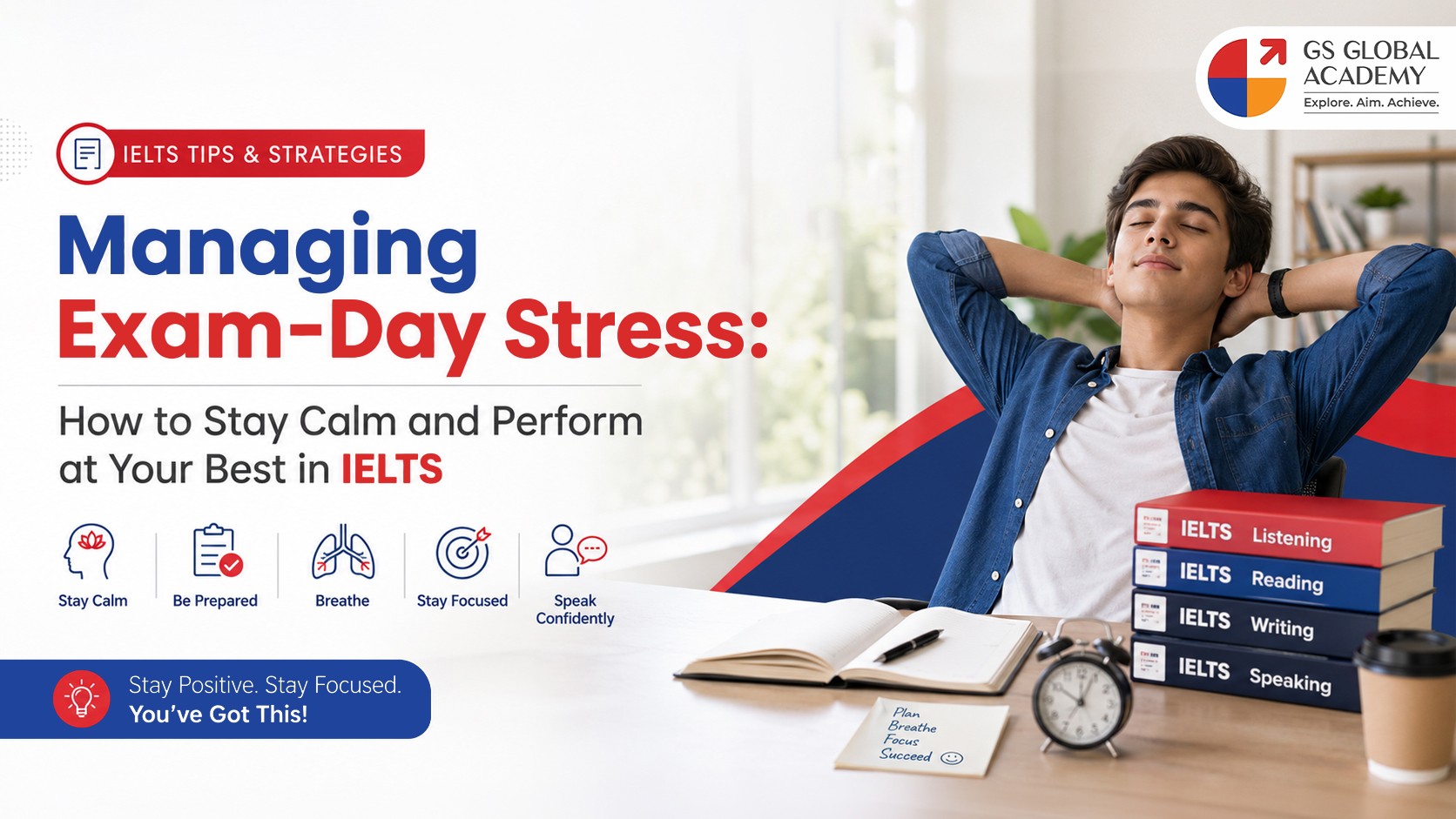
You have prepared for weeks—or perhaps months. You have attended classes, completed practice tests, learnt new vocabulary, worked on your grammar, and practised speaking in front of a teacher or a partner. Yet, when the actual IELTS exam day arrives, everything can suddenly feel different.
Your heart starts beating faster. You look at the clock repeatedly. You begin wondering, “What if I forget everything?” or “What if I get a difficult topic?” Even simple questions may suddenly seem confusing.
This is exam-day stress, and it is far more common than most IELTS candidates realise.
The good news is that feeling nervous does not mean you are unprepared or that you will perform badly. A little nervousness is natural. The key is to prevent that nervousness from taking control of your performance.
The IELTS Exam Is Not a Test of Perfection
One of the biggest sources of stress among IELTS candidates is the belief that they must give perfect answers.
They don’t.
IELTS is not looking for someone who speaks English without making a single mistake. The test assesses your ability to communicate effectively in English. A small grammar mistake, a moment of hesitation, or an unfamiliar word does not automatically ruin your score.
Many students lose confidence because they make one mistake and then spend the next few minutes thinking about it:
“I made a mistake in the first answer. My Speaking test is ruined.”
No. One mistake is simply one mistake. The real problem begins when you allow that mistake to affect the rest of your performance.
Your goal is not perfection. Your goal is to communicate clearly and confidently.
Prepare Your Mind Before You Prepare Your Materials
Most candidates focus on what to carry to the exam centre, but very few prepare their minds.
The night before the exam, avoid last-minute panic studying. Trying to learn 100 new words at midnight will probably make you more anxious rather than more prepared.
Instead:
- Review only important notes or strategies.
- Avoid attempting a full mock test late at night.
- Keep your identification documents and other essentials ready.
- Set an alarm and plan your journey in advance.
- Try to get adequate rest.
The aim is to arrive at the test centre with a calm mind—not an exhausted one.
Sometimes, one extra hour of sleep can help you more than one extra hour of studying.
Reach the Test Centre Early
Rushing into the examination centre at the last minute can immediately increase your stress levels.
Traffic, finding the location, completing formalities, or simply worrying about being late can consume your mental energy before the test even begins.
Plan your journey beforehand and aim to reach early. When you have enough time, you can:
- Settle down comfortably.
- Complete the necessary procedures without panic.
- Visit the washroom.
- Take a few deep breaths.
- Mentally prepare yourself for the test.
You want to enter the exam room thinking:
“I am ready to do my best.”
—not—
“Oh no! I am already late!”
Use Your Breath to Calm Your Body
When you feel anxious, your body often reacts before your mind does. Your heartbeat increases, your breathing becomes shallow, and your muscles become tense.
One of the simplest ways to calm your body is through controlled breathing.
Try this:
- Breathe in slowly for four seconds.
- Hold your breath for two seconds.
- Breathe out slowly for six seconds.
Repeat this a few times.
The longer exhalation helps your body relax. You do not need to perform complicated meditation techniques in the exam room. Sometimes, just taking a few slow, conscious breaths is enough to help you regain focus.
Do Not Let One Difficult Question Affect the Whole Test
This is especially important in the Listening and Reading sections.
You may come across a question that you do not know the answer to. You may miss an answer in Listening. You may find one passage in Reading unusually difficult.
It is natural to feel frustrated.
But do not spend several minutes thinking about that one question.
If you miss an answer, move on. If you get stuck on a Reading question, make the best possible decision and continue. Remember:
One difficult question is worth only one mark. Losing your concentration for the next five questions can cost you much more.
The exam rewards your overall performance—not your ability to answer every question perfectly.
In Writing, Spend a Few Minutes Planning
Many candidates begin writing immediately because they are worried about time. However, starting without a plan can often lead to repetition, poor organisation, and irrelevant ideas.
Before you begin writing, take a few minutes to understand the question and organise your ideas.
Ask yourself:
- What exactly is the question asking?
- What is my position or main opinion?
- What are my two or three main ideas?
- What examples can I use?
- How will I organise my paragraphs?
A simple plan can save you a lot of time later.
Remember, a well-organised essay with clear ideas is usually better than a long essay filled with disconnected thoughts.
In Speaking, have a Conversation—Don’t Perform a Speech
Many candidates become nervous in the Speaking test because they feel they are being judged every second.
Try to change your mindset.
The examiner is not expecting you to sound like a newsreader or a professor. The Speaking test is a conversation. Listen carefully to the question and respond naturally.
If you do not understand a question, it is perfectly acceptable to ask:
“Could you please repeat the question?”
If you need a moment to think, you can use natural phrases such as:
- “That’s an interesting question.”
- “I’ve never really thought about that before, but…”
- “Well, in my opinion…”
These expressions can give you a moment to organise your thoughts.
You do not need to memorise complete answers. In fact, memorised answers can sometimes sound unnatural and may make you even more nervous if the examiner asks a slightly different question.
Speak naturally. Explain your ideas. Give examples. Be yourself.
Stop Comparing Yourself with Other Candidates
One of the most stressful experiences on exam day is listening to other candidates.
Someone may speak fluently. Someone may discuss an impressive vocabulary word. Someone may say they found the test easy.
Do not allow their performance to affect your confidence.
You do not know:
- How well they actually performed.
- What their target score is.
- What their strengths and weaknesses are.
- Whether their confidence reflects their actual performance.
Your IELTS test is your journey.
The person sitting next to you is not your competition. Your focus is your own performance.
Use Positive Self-Talk
The way you speak to yourself can significantly influence your confidence.
Instead of saying:
“I am going to fail.”
“My English is terrible.”
“I always make mistakes.”
Try saying:
“I have prepared for this.”
“I do not need to be perfect.”
“I can handle one question at a time.”
“If I make a mistake, I will continue.”
“I will focus on what I can control.”
This is not about pretending that the exam is easy. It is about reminding yourself that you are capable of handling the situation.
The Most Important Rule: Don’t Panic After a Mistake
You will probably make at least one mistake during the IELTS test.
You may miss an answer. You may spell a word incorrectly. You may use the wrong tense. You may pause while speaking.
That is okay.
A mistake becomes more damaging when you continue thinking about it.
Imagine accidentally spilling a little water on a page. You would not throw away the entire book because of it. Similarly, one mistake should not make you believe that your entire test is ruined.
Notice it. Let it go. Move forward.
Final Thoughts
The IELTS exam tests more than your English skills. It also tests your ability to remain focused when you feel pressure.
You do not have to walk into the exam centre feeling completely fearless. Even confident candidates feel nervous. The aim is not to eliminate nervousness completely; it is to learn how to manage it.
Take a deep breath.
Read the question carefully.
Listen attentively.
Speak naturally.
Write clearly.
And remember that you have already done the hard work by preparing.
On exam day, your job is simple:
Do not try to be perfect. Just stay calm, trust your preparation, and give the best performance you can.
Sometimes, the biggest difference between a nervous candidate and a confident candidate is not knowledge.
It is simply the ability to say:
“I may feel nervous—but I can still do this.”
About the Author

Ashvini Dhadve
Ashvini Dhadve is a seasoned Training and Development professional with over 18 years of experience in education and corporate training. She holds a B.Sc. in Physics, an MBA in Human Resources, and LL.B. and LL.M. degrees, bringing a unique blend of academic and professional expertise. A Certified Trainer for IELTS, TOEFL, and PTE, Ashvini has trained thousands of students, job seekers, and professionals in English language proficiency, communication skills, soft skills, and career development. Known for her practical, learner-focused approach, she is passionate about helping individuals build confidence, enhance employability, and achieve their academic and professional goals.