
The IELTS Speaking Test assesses how effectively you communicate in English, express opinions, describe experiences and participate in conversations. It is an important part of the IELTS examination and requires candidates to demonstrate fluency, vocabulary, grammatical accuracy and clear pronunciation.
For Indian students planning to study abroad, preparing for the IELTS Speaking Test involves more than learning English grammar or memorising vocabulary. Candidates need to understand the examination format, practise different speaking topics and develop the ability to organise their thoughts while responding to questions.
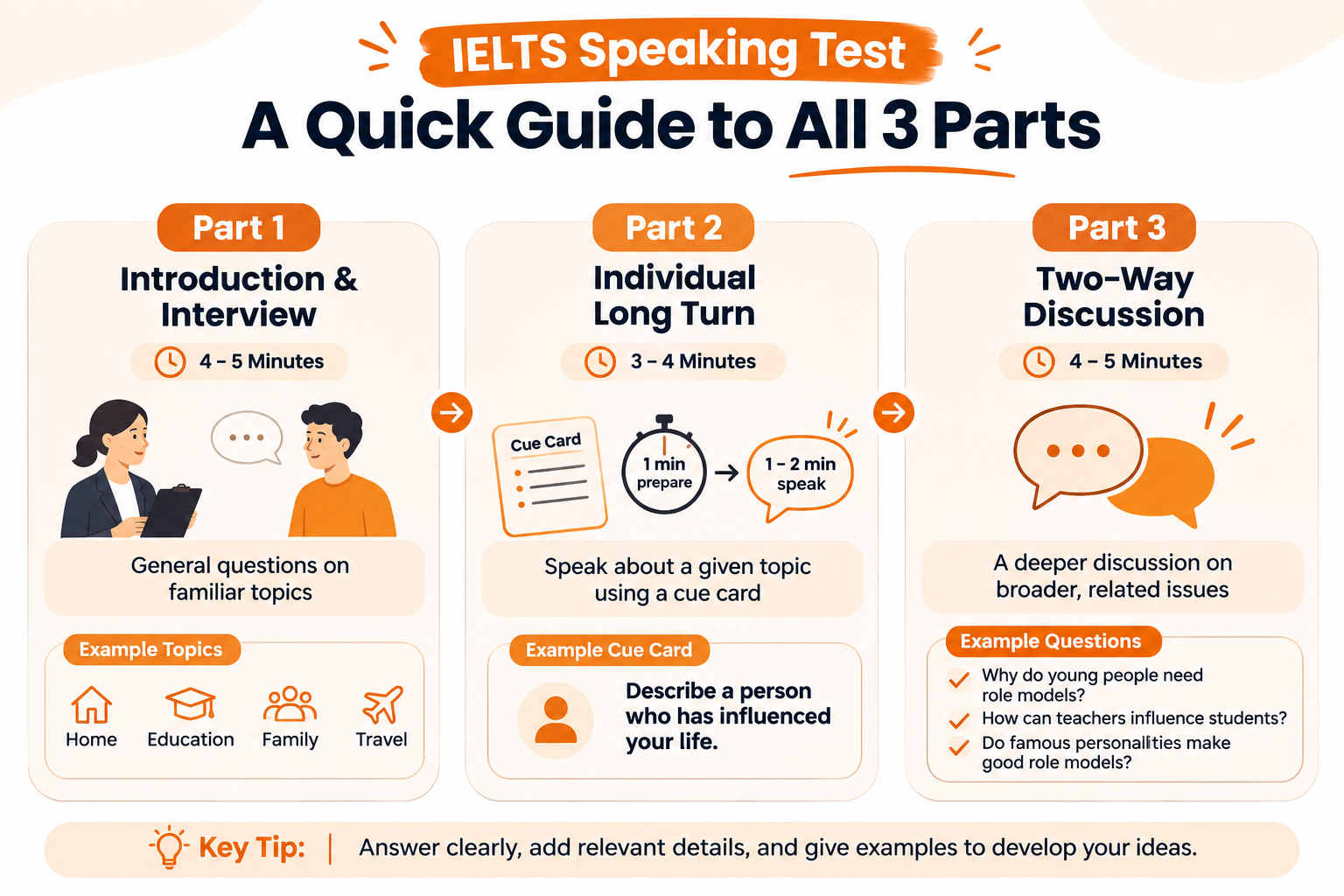
The IELTS Speaking Test lasts between 11 and 14 minutes and consists of three parts: an introduction and interview, an individual long turn and a two-way discussion. Examiners assess candidates using four equally weighted criteria: Fluency and Coherence, Lexical Resource, Grammatical Range and Accuracy, and Pronunciation.
Whether you are preparing for IELTS Academic or IELTS General Training, understanding these sections can help you organise your preparation more effectively.
In this guide, we explain the IELTS Speaking Test format, common IELTS speaking test questions, important speaking topics, assessment criteria and practical preparation tips for Indian students.
IELTS Speaking Test: Quick Overview
| Test Component | Details |
| Test duration | 11–14 minutes |
| Number of parts | 3 |
| Part 1 | Introduction and Interview |
| Part 2 | Individual Long Turn |
| Part 3 | Two-Way Discussion |
| Preparation time for Part 2 | 1 minute |
| Speaking time for Part 2 | 1–2 minutes |
| Assessment criteria | 4 equally weighted criteria |
| Test types | IELTS Academic and IELTS General Training |
The Speaking Test has the same format for IELTS Academic and IELTS General Training candidates.
What Is the IELTS Speaking Test?
The IELTS Speaking Test is an assessment of a candidate’s ability to communicate effectively in spoken English. It is conducted as an interview with an IELTS examiner and is recorded.
The examination evaluates how well candidates can discuss familiar subjects, describe experiences, express opinions and respond to more complex questions.
Candidates are assessed on four criteria:
- Fluency and Coherence: How smoothly you speak and organise your ideas logically.
- Lexical Resource: Your ability to use appropriate vocabulary accurately and effectively.
- Grammatical Range and Accuracy: Your ability to use a variety of grammatical structures correctly.
- Pronunciation: How clearly and understandably you communicate through speech.
Each criterion contributes equally to the Speaking assessment.
Understanding these four criteria is important because speaking quickly, using complicated vocabulary or memorising expressions does not independently determine your IELTS Speaking performance.
Why Is the IELTS Speaking Test Important?
The IELTS Speaking Test evaluates your ability to communicate in English in different situations. It forms one of the four sections of IELTS, alongside Listening, Reading and Writing.
For Indian students considering international education, English-language proficiency may be part of the admission requirements set by universities and institutions. The required IELTS score depends on the institution, course and other applicable requirements.
Preparing for the Speaking section can help candidates develop skills such as:
- Expressing opinions clearly.
- Explaining personal experiences.
- Participating in discussions.
- Comparing different ideas and situations.
- Describing people, places and events.
- Responding to questions without relying on memorised answers.
The assessment also encourages candidates to develop a balanced combination of fluency, vocabulary, grammar and pronunciation.
Where and When Is the IELTS Speaking Test Conducted?
Where does the IELTS Speaking Test take place?
The Speaking Test is conducted as an interview with an IELTS examiner. Depending on the test provider and local arrangements, the interview may be conducted face-to-face or through an approved video-call arrangement.
Candidates should refer to their official booking confirmation for the specific test location and delivery format.
When is the IELTS Speaking Test conducted?
The Speaking Test may take place on the same day as the Listening, Reading and Writing sections or on a separate day.
The schedule depends on the test provider and local test arrangements. Candidates should check their test confirmation for the exact date and reporting time.
It is advisable to include speaking practice throughout your IELTS preparation rather than concentrating on it only shortly before the examination.
Understanding the Three Parts of the IELTS Speaking Test
The IELTS Speaking Test consists of three parts. Each section evaluates a different aspect of spoken communication.
Part 1: Introduction and Interview (4–5 Minutes)
The examiner introduces themselves, checks your identity and asks general questions about familiar subjects.
This section focuses on your ability to communicate information and express opinions about everyday experiences.
Common IELTS Speaking Part 1 topics include:
- Home and hometown
- Education and studies
- Work and occupation
- Family and friends
- Hobbies and interests
- Daily routines
- Food and cooking
- Music and entertainment
- Travel and holidays
Sample IELTS Speaking Part 1 questions
- Where do you live?
- What do you enjoy doing in your free time?
- Do you prefer studying alone or with others?
- What kind of books do you enjoy reading?
- How do you usually spend your weekends?
- What is your favourite subject, and why?
- Do you enjoy cooking?
- How often do you travel?
Example: How to develop your answer
Question: Do you enjoy reading books?
Short response:
Yes, I enjoy reading books.
More developed response:
Yes, I enjoy reading books, particularly those related to personal development and real-life experiences. Reading gives me an opportunity to learn new things and explore different perspectives.
The second response provides additional relevant information and demonstrates how a candidate can develop an answer naturally.
Preparation tip: Answer the question directly and add relevant details. Avoid giving only one-word answers or extending your response with unrelated information.
Part 2: Individual Long Turn (3–4 Minutes)
In Part 2, the examiner gives you a task card containing a topic and supporting points.
You receive one minute to prepare and make notes. You are then expected to speak for one to two minutes about the topic.
The examiner may ask a brief follow-up question after your response.
Example IELTS Speaking Part 2 cue card
Describe a person who has influenced your life.
You should say:
- Who the person is.
- How you know this person.
- What qualities you admire about them.
- How this person has influenced your life.
How to organise your response
You can organise your ideas into four sections:
- Introduction: Identify the person.
- Background: Explain how you know them.
- Main details: Describe their qualities and experiences.
- Conclusion: Explain why their influence is important to you.
Example approach:
You could discuss a teacher, family member, friend or another person who has influenced your decisions. Explain a specific experience, describe what you learned and connect it to the person’s influence on your life.
How to use the one-minute preparation time
If the cue card asks you to describe a memorable journey, your notes could include:
| Preparation Point | Keywords |
| Destination | Place and location |
| Travel companions | Friends or family |
| Activities | Sightseeing, food or experiences |
| Memorable moment | An interesting incident |
| Importance | Why the journey was meaningful |
These notes can help you maintain a logical flow without writing complete sentences.
Preparation tip: Practise speaking on different cue card topics using a timer. Focus on developing your ideas and maintaining a natural flow.
Part 3: Two-Way Discussion (4–5 Minutes)
Part 3 involves a discussion with the examiner about broader issues connected to the subject introduced in Part 2.
Unlike Part 1, which focuses mainly on familiar experiences, Part 3 may require you to explain opinions, compare situations, discuss social changes and consider different perspectives.
Example questions related to influential people
- Why do young people need role models?
- How can teachers influence students?
- Do famous personalities always make good role models?
- How has the influence of celebrities changed with social media?
- Do you think parents have a greater influence on children than teachers?
How to develop your answers
Question: Why do young people need role models?
Short response:
Young people need role models because they can learn from them.
More developed response:
I believe role models can influence the way young people approach their personal and professional goals. For example, students may learn important qualities such as discipline, responsibility and determination by observing people they admire. However, it is also important to develop independent opinions rather than following someone without question.
The developed response explains an opinion, provides reasoning and introduces another perspective.
Preparation tip: Practise explaining why you hold an opinion. Use relevant examples and comparisons to develop your responses rather than relying on short statements.
10 Practical IELTS Speaking Test Tips for Indian Students
Preparing for IELTS Speaking requires consistent practice across all four assessment criteria. The following strategies can help you improve your communication skills and become more familiar with the examination format.
1. Practise Speaking English Regularly
Make speaking practice part of your daily routine.
Choose familiar subjects such as education, hobbies, travel, technology or current social issues and explain your thoughts aloud.
You can practise with a friend, study partner or language instructor. Recording your responses is another way to review your speaking performance.
Listen to your recordings and identify areas where you hesitate, repeat words or struggle to organise your thoughts.
2. Avoid Translating Every Sentence Mentally
Some candidates may pause frequently because they first construct sentences in another language and then translate them into English.
Try expressing simple thoughts directly in English.
For example, describe your daily activities, explain your plans, discuss a recent experience or talk about a subject that interests you.
Practising this approach can help you become more comfortable forming sentences while speaking.
3. Develop Topic-Based Vocabulary
Lexical Resource is one of the four IELTS Speaking assessment criteria.
Instead of memorising long lists of difficult words, learn vocabulary related to different subjects and practise using it in context.
Important IELTS speaking topics include:
| Topic | Vocabulary Areas |
| Education | Learning, qualifications, academic performance |
| Environment | Pollution, conservation, sustainability |
| Technology | Innovation, communication, digital services |
| Health | Nutrition, fitness, lifestyle |
| Travel | Destinations, accommodation, tourism |
| Culture | Traditions, heritage, celebrations |
| Career | Employment, professional development, skills |
| Social Media | Online communication, content, privacy |
| Food | Nutrition, ingredients, eating habits |
| Family | Relationships, responsibilities, generations |
For example, when discussing education, you could practise words such as academic performance, practical learning, higher education and career opportunities.
Focus on understanding the meaning and appropriate usage of vocabulary rather than inserting complicated words into every answer.
4. Practise Different IELTS Speaking Test Questions
Become familiar with the question formats used in Parts 1, 2 and 3.
Practise answering questions about personal experiences as well as broader subjects that require you to explain an opinion.
For example:
- Part 1: What do you enjoy doing during your holidays?
- Part 2: Describe a memorable holiday you experienced.
- Part 3: How has tourism changed over the years?
Notice how these questions connect to a common subject but require different types of responses.
Avoid memorising complete answers. Instead, develop the ability to respond naturally to different questions.
5. Organise Your Answers Before Speaking
A clear structure can help you communicate your ideas more effectively.
For opinion-based questions, try the following approach:
Opinion – Reason – Example – Explanation
- Opinion: Explain what you think.
- Reason: Describe why you hold that opinion.
- Example: Provide a relevant example.
- Explanation: Connect the example to your main point.
For instance:
Question: Do you think technology has improved education?
Example response:
I believe technology has made education more accessible. One reason is that students can now access digital learning resources and educational materials through online platforms. For example, students can use recorded lessons and online study resources to explore subjects beyond their classroom. This provides additional opportunities to learn at their own pace.
This is a practice structure, not a compulsory formula for every IELTS question.
6. Work on Pronunciation and Clarity
Pronunciation is an important part of IELTS Speaking assessment.
Listen to English conversations, interviews and educational recordings. Pay attention to:
- Correct pronunciation of individual words.
- Word and sentence stress.
- Intonation.
- Rhythm and speech clarity.
- How meaning changes through emphasis.
You do not need to imitate a British, American or any other particular accent. Focus on making your speech understandable.
Recording yourself and listening to your pronunciation can help you identify words and sounds that require additional practice.
7. Avoid Memorising Complete Responses
Prepared answers may not address the exact question asked by the examiner.
Instead of learning complete responses, prepare ideas, vocabulary and examples for different subjects.
For example, you can prepare to discuss education from different perspectives:
- The importance of education.
- Online versus classroom learning.
- The role of teachers.
- Education and career opportunities.
Practise expressing the same idea in different ways so that you can respond more flexibly.
8. Use the Part 2 Preparation Time Effectively
Part 2 provides one minute to prepare before you begin speaking.
Use this time to identify the main points you want to discuss.
For example, if the topic asks you to describe a memorable journey, make notes about:
- Destination.
- Travel companions.
- Activities.
- Memorable experience.
- Why the journey was important.
Use keywords instead of writing complete sentences. This will give you a simple structure to follow during your response.
9. Learn to Respond to Unfamiliar Questions
Not every question will be about a subject you know well.
When you encounter an unfamiliar question, take a short moment to organise your thoughts. Explain your perspective and support your response with relevant reasoning.
You can use natural expressions such as:
- In my opinion…
- From my perspective…
- One possible reason is…
- I would consider this important because…
- Another way to look at this is…
Use these expressions only when they fit the conversation. Avoid repeating the same phrases in every answer.
10. Practise with Mock Speaking Tests
Mock tests can help you become familiar with the three-part examination structure.
Practise answering questions within the specified time limits. If possible, ask an English instructor or proficient speaker to review your performance.
Pay attention to:
- Frequent pauses and repetitions.
- Vocabulary range and word choice.
- Grammar errors.
- Pronunciation and clarity.
- Organisation of ideas.
- Ability to develop responses.
Practise all three sections in one sitting to become familiar with the overall examination sequence.
Reviewing your responses can help you identify areas that require additional practice.
Common IELTS Speaking Topics and Practice Questions
Preparing for different IELTS speaking topics can help you become familiar with a range of subjects.
The following table provides illustrative practice questions. These are not official predictions of actual examination questions.
| IELTS Speaking Topic | Part 1 Practice Question | Part 3 Practice Question |
| Education | What subject did you enjoy studying at school? | How can education systems improve? |
| Technology | Do you use technology every day? | How has technology changed communication? |
| Environment | Do you enjoy spending time outdoors? | What can individuals do to reduce pollution? |
| Travel | Do you enjoy visiting new places? | Why has international tourism become popular? |
| Career | What kind of work would you like to do? | What factors influence career choices? |
| Health | Do you enjoy exercising? | Why is regular physical activity important? |
| Social Media | Which social media platforms do you use? | How does social media influence communication? |
| Culture | What traditional celebrations do you enjoy? | Why is preserving cultural heritage important? |
| Hobbies | What do you enjoy doing in your free time? | How do hobbies influence people’s lives? |
| Food | What is your favourite type of food? | How have people’s eating habits changed? |
Additional IELTS Speaking Part 2 Cue Card Topics
Practise organising a one-to-two-minute response for the following subjects:
- Describe a person who has influenced your life.
- Describe a memorable journey you have taken.
- Describe a book that you enjoyed reading.
- Describe a skill you would like to learn.
- Describe a place you would like to visit.
- Describe an important decision you made.
- Describe a memorable event in your life.
- Describe a person who inspires you.
- Describe a useful piece of technology.
- Describe a time when you helped someone.
For each topic, practise identifying the main points, preparing relevant examples and developing your response logically.
How Is the IELTS Speaking Test Scored?
IELTS examiners assess Speaking performance using four equally weighted criteria. Each criterion contributes 25% to the Speaking assessment.
Understanding these assessment areas can help candidates identify what they need to practise.
1. Fluency and Coherence
Fluency and Coherence evaluates how effectively you communicate your ideas without unnecessary interruptions and how logically you organise your speech.
It includes:
- Speaking with a natural flow.
- Avoiding excessive hesitation and repetition.
- Connecting ideas logically.
- Developing responses relevant to the question.
- Using linking expressions appropriately.
Preparation focus: Practise explaining your thoughts in complete, connected responses rather than giving disconnected statements.
2. Lexical Resource
Lexical Resource evaluates the range, accuracy and appropriateness of the vocabulary you use.
It includes:
- Choosing appropriate words.
- Using vocabulary accurately.
- Expressing ideas in different ways.
- Paraphrasing when necessary.
- Using topic-related vocabulary appropriately.
Preparation focus: Learn vocabulary in context and practise using different expressions to communicate the same idea.
3. Grammatical Range and Accuracy
This criterion evaluates the variety and accuracy of grammatical structures used during the test.
It includes:
- Correct sentence formation.
- Appropriate verb tenses.
- Accurate use of articles and prepositions.
- Different sentence structures.
- Appropriate use of complex sentences.
Preparation focus: Practise both simple and complex sentence structures. Focus on accuracy rather than using complicated grammar unnecessarily.
4. Pronunciation
Pronunciation evaluates how clearly and understandably you communicate through speech.
It includes:
- Clear pronunciation of words.
- Appropriate word and sentence stress.
- Intonation.
- Rhythm.
- Overall intelligibility.
Preparation focus: Listen to spoken English, practise difficult words and record your responses to review clarity and pronunciation.
IELTS Speaking Assessment Summary
| Assessment Criteria | Main Focus | Preparation Priority |
| Fluency and Coherence | Flow and organisation of ideas | Regular speaking practice |
| Lexical Resource | Vocabulary range and accuracy | Topic-based vocabulary |
| Grammatical Range and Accuracy | Grammar variety and correctness | Sentence-building exercises |
| Pronunciation | Clarity and intelligibility | Listening and pronunciation practice |
Candidates should develop all four skills rather than concentrating exclusively on vocabulary or fluency.
For detailed assessment information, refer to the official IELTS Speaking assessment criteria.
How Can Indian Students Prepare for IELTS Speaking at Home?
Candidates can organise their preparation using a consistent practice routine.
Here is an illustrative seven-day speaking practice schedule:
| Day | Practice Activity | Focus Area |
| Day 1 | Practise 10 Part 1 questions | Familiar topics and fluency |
| Day 2 | Learn vocabulary related to education and technology | Lexical Resource |
| Day 3 | Practise two Part 2 cue cards | Organisation and speaking continuity |
| Day 4 | Practise Part 3 discussion questions | Developing opinions |
| Day 5 | Record and review speaking responses | Pronunciation and grammar |
| Day 6 | Complete a full mock Speaking Test | Test familiarity |
| Day 7 | Review mistakes and repeat difficult questions | Identifying areas for improvement |
This is a suggested practice schedule, not an official IELTS preparation requirement. Candidates can adjust the activities according to their preparation needs.
Useful Resources for IELTS Speaking Preparation
You can use official preparation materials to understand the examination format and practise different speaking tasks.
- IELTS Official – Speaking Test Format
- British Council – IELTS Speaking Preparation
- IDP India – IELTS Speaking Test
- British Council – IELTS Speaking Fluency and Coherence Tips
These resources provide information about the test structure, assessment criteria and preparation activities.
Conclusion
Preparing for the IELTS Speaking Test involves developing the ability to communicate clearly, organise ideas and respond naturally to different questions.
For Indian students, regular speaking practice, vocabulary development, pronunciation exercises and familiarity with IELTS speaking topics can form useful parts of an examination preparation routine.
Understanding the three test sections and the four assessment criteria can also help you identify areas that require additional attention.
If you are preparing for IELTS and looking for structured information about IELTS coaching and test preparation in Pune, explore the IELTS Classes in Pune at GS Global Academy.
Visit GS Global Academy to learn more about its academic and test preparation offerings.
About the Author